Author: Philip Bethge

  • Small Is Beautiful: Nuclear Industry Pins Hopes on Mini-Reactors

    The nuclear energy industry hopes to secure its future through miniature nuclear reactors. The small underground plants will supposedly be safer than large plants, and would lower the cost of electricity from nuclear power. But critics say that the electricity the plants produce will be too expensive and warn of the risk of proliferation.

    By Philip Bethge

    In Galena, a town in icy central Alaska, energy is indispensable — but expensive. Although diesel generators provide plenty of electricity, the town’s roughly 600 residents regularly receive monthly electric bills in the hundreds of dollars.

    But the future could soon arrive in this tiny town on the Yukon River. “Super-Safe, Small and Simple,” or “4S,” is the name of a machine that could soon be buried 30 meters (98 feet) below the icy soil and placed into service.

    The hot core of the device, developed by the Japanese company Toshiba, measures only 2 meters by 0.7 meters (6 feet 7 inches by 2 feet 4 inches). But despite its diminutive size, it is expected to deliver 10 megawatts of electricity. “4S” is a nuclear reactor, and Galena could become a test case for a new kind of electricity generation.

    The nuclear power industry hopes to secure its future with miniature reactors for civilian use. The concept of mini nukes that could produce up to 300 megawatts of electricity has been remarkably well received, particularly in the United States. Nine designs are competing for the attention of electric utilities and the US Nuclear Regulatory Commission (NRC), the government agency that regulates nuclear power plants.

    The Nuclear PR Machine

    Critics, like physicist Edwin Lyman of the Union of Concerned Scientists, are convinced that the projects are all in the “stage of fantasy.” Jim Riccio, a nuclear expert with the environmental organization Greenpeace, blames the “hype” on the “well-oiled PR machine of the nuclear industry.”

    But the movement has prominent supporters. Microsoft co-founder Bill Gates, for example, has invested in a company called TerraPower, which plans to build innovative small reactors. US President Barack Obama has pledged to provide $54 billion (€40 billion) in loan guarantees for the nuclear industry.

    And for Energy Secretary Steven Chu, who is a winner of the Nobel Prize in Physics, it goes without saying that a portion of these loan guarantees will be available for miniature reactors of what he calls the “plug and play” variety. Small modular reactors are “one of the most promising areas” in the nuclear industry, Chu wrote recently in an enthusiastic opinion piece in the Wall Street Journal.

    Proponents of nuclear power present the following arguments in favor of the idea:

    • Small reactors could become available in the future at bargain prices of less than $600 million, and they would only take two to three years to build. By comparison, reactors in the gigawatt range cost more than $5 billion, and financing is often a challenge. Some projects, such as the current construction of a new reactor in Olkiluoto, Finland, are years behind schedule and vastly over budget.
    • Because they are delivered pre-assembled, mini-reactors could also be used in countries without domestic nuclear experts. The plants produce about as much energy as gas or coal power plants and could therefore simply replace them. Existing power grids and turbines could still be used.
    • The miniature reactors unleash their fissile power from locations deep underground, which would make it difficult for terrorists to steal fissile material.

    “Small nuclear reactors are cheaper, safer and more flexible,” raves Tom Sanders, president of the American Nuclear Society. Sanders wants to mass-produce nuclear power plants, just as Henry Ford did with cars in his time, and make them available around the world, particularly in developing countries.

    ‘Global Interest’

    “There is certainly a global interest in these kinds of systems,” says Chris Mowry of Babcock & Wilcox, a producer of nuclear power plants based in Lynchburg, Virginia. In the past, the company earned much of its revenue with reactors that power nuclear submarines, but now it has developed one of the most promising mini-reactors for civilian energy use.

    The mPower reactor is a conventional, 125-megawatt pressurized water reactor. Once it has been buried underground, it is expected to continue producing electricity for 60 years. One of the device’s most appealing features is that spent fuel assemblies are stored in the reactor shell, making them virtually inaccessible. The steam generator is also integrated into the unit.

    “All key components can be manufactured in one single factory,” Mowry says enthusiastically. Three large US electric utilities have shown interest in the technology. The utilities are particularly attracted to the idea of building nuclear power plants in modular fashion in the future. When one reactor has run its course, the next one can be ordered. However, the mPower reactor has yet to obtain NRC approval, which could take years.

    A consortium led by US nuclear power producer Westinghouse is pursuing a similar approach. Its Iris reactor would produce 335 megawatts of power and is one of the leading candidates for the Global Nuclear Energy Partnership (GNEP).

    Part 2: Old Reactors Returned Like Empty Deposit Bottles

     Since 2006, the US government has championed the GNEP project, which it hopes could meet the growing energy demands of developing countries. Under GNEP, the nuclear powers would ship complete mini-reactors with sealed reactor cores to developing countries. The plants would be designed to operate without maintenance for close to 30 years. After that, they would simply be returned, like empty deposit bottles, to the country where they were manufactured.

    The United Kingdom, France, Canada, China and Japan are among the GNEP donor nations. Countries like Jordan, Kazakhstan and Senegal have shown interest in the small reactors. In return for receiving the plants, they would pledge not to engage in reprocessing or uranium enrichment.

    Critics are horrified. They fear that fissile material could end up in the wrong hands all too easily. “Anyone who ships this stuff all over the world shouldn’t be surprised if it comes back in the form of dirty bombs,” says Greenpeace expert Jim Riccio.

    Physicist Edwin Lyman agrees, saying that it is preferable to concentrate the technology in only a few places. “I am concerned about exporting these plants to countries that have no experience with nuclear energy and where there are security concerns and corruption.”

    Reusing Old Reactors

    Critics are also concerned about the plans of Akme, a Russian company. The firm, which was established in December 2009, engages in the typically Russian practice of reusing old equipment: It intends to convert a reactor used in Soviet nuclear submarines into a civilian reactor.

    The project is extremely controversial. The reactors operate with relatively highly enriched uranium, which is more easily used to build bombs. In addition, they are cooled in a toxic lead-bismuth alloy.

    In addition to safety and security concerns, there are doubts about the mini-reactor’s economic efficiency. In the United States, the costs of licensing a nuclear power plant alone range from $50 million to $100 million. In addition, strict safety requirements make small reactors disproportionately more expensive than larger plants.

    This leads physicist Amory Lovins of the Rocky Mountain Institute in Colorado to believe that small reactors will “never be competitive.” Reactor manufacturers expect to see costs of between $3,500 and $5,000 per kilowatt of installed power for the dwarf nuclear power plants. The same value ranges from $900 to $2,800 for coal power plants and $520 to $1,800 for natural gas power plants. Even wind turbines can be built for $1,900 to $3,700 per kilowatt.

    ‘Not a Sign of Economic Health’

    The nuclear industry expects CO2 emissions trading to make nuclear technology, which is largely climate-neutral, more competitive soon. “But the same also applies to hydroelectric power, wind and solar energy,” says Lovins.

    “The nuclear industry is desperately trying to make itself look vital,” says the professor. “But government loan guarantees are not a sign of economic health, just as blood transfusions are not a sign for medical health.”

    Fans of the new miniature reactor world aren’t allowing the grumblers to spoil their mood. Instead, they are developing bolder and bolder projects for the future. For example, nuclear scientist Tom Sanders and a team at the Sandia National Laboratory are developing a reactor that would cost only about $250 million at a planned production rate of 50 reactors per year. Liquid sodium cools the uranium core of the plant, which resembles a sort of replaceable cartridge.

    TerraPower, the company Bill Gates has invested in, is working on a so-called traveling-wave reactor. In this type of reactor, the fission zone travels slowly through an elongated fuel core. Plutonium is bred from depleted uranium and then immediately burned off. The engineers rhapsodize over the system, saying that this “wave of fission” could generate electricity continuously “for 50 to 100 years without refueling or removing any used fuel from the reactor.”

    Is it the holy grail of nuclear engineering? The traveling-wave reactor still doesn’t exist outside supercomputers. TerraPower has just entered into a joint venture agreement with Toshiba. The two companies plan to move forward together with the development of a mini-nuke future.

    Renewable Energy

    The Japanese might already be finding proof of their capacity for innovation in Galena, the town on Alaska’s Yukon River, if only they hadn’t run into problems with approval for their “4S” reactor.

    For now, the residents of Galena have turned to another innovative energy source, paid for with subsidies from Alaska’s renewable energy fund: wood-burning stoves.

    Translated from the German by Christopher Sultan

    –> read original story at SPIEGEL Online International

  • Google Co-Founder on Pulling out of China: ‘It Was a Real Step Backward’

    Last week, Google announced it would withdraw its Chinese operations from Beijing and instead serve the market from freer Hong Kong. The Internet giant’s co-founder, Sergey Brin, 36, discusses his company’s troubles in China and its controversial decision to pull up stakes and leave.

    SPIEGEL: With your decision to close Google’s Chinese Web site, you are the first major company to have challenged the government in Beijing in this way. Are you powerful enough to take on an entire country?

    Brin: I don’t think it’s a question of taking on China. In fact, I am a great admirer of both China and the Chinese government for the progress they have made. It is really opposing censorship and speaking out for the freedom of political dissent, and that’s the key issue from our side.

    SPIEGEL: Four years ago, you allowed your service to be censored. Why have you changed your mind now?

    Brin: The hacking attacks were the straw that broke the camel’s back. … More

  • Saving Moon Trash: Urine Containers, ‘Space Boots’ and Artifacts Aren’t Just Junk, Argue Archaeologists

    California has named the remains of the Apollo 11 mission a state historical resource — to the delight of the young profession of space archaeologists. They fear that the trash and equipment left behind by the United States’ journeys to the moon could someday wind up for sale on eBay if they aren’t protected.

    There is an unwritten law in America’s national parks: Carry out what you bring in.

    When they visited the moon, though, the Americans weren’t nearly as considerate or in touch with nature. Astronauts Buzz Aldrin and Neil Armstrong left behind more than 100 items when they left the moon on July 21, 1969, at 5:54 p.m., Earth Time. The items included four urine containers, several airsickness bags, a Hasselblad camera, lunar overshoes and a complete moon-landing step.

    The mission was historically significant. But are the urine containers? (more…)

  • Tribulations at Toyota: The Search for the Gas Pedal Flaw

    Toyota has recalled millions of vehicles due to reports of sticking gas pedals and unintended acceleration. But finding out exactly what causes the problem has proven difficult. An explanation for why most of the accidents have occurred in the US has likewise proven elusive.

    It is an agonizing predicament that Toyota finds itself in — the most excruciating in the company’s history. Vehicles accelerating on their own continue to cause problems, and the inability to bring the matter to a close could spell ruin for the company.

    Worn down Toyota managers wanted to bring a little optimism to the Geneva Motor Show last week, but the latest bad news — that repairs failed to solve the carmaker’s gas pedal problem — ruined the mood. Numerous Toyota drivers in the United States … More

  • Modern Day Flintstones: A Stone Age Subculture Takes Shape

    A modern-day Stone Age subculture is developing in the United States, where wannabe cavemen mimic their distant ancestors. They eat lots of meat, bathe in icy water and run around barefoot. Some researchers say people led healthier lives in pre-historic times.

    By Philip Bethge

    John Durant greets the hunter-gatherers of New York once a month in his apartment on the Upper East Side. They eat homemade beef jerky, huddle around the hearth and swap recipes for carpaccio with vegetables or roasted wild boar.

    Often enough, the host will deliberately skip a few meals the next day. After all, didn’t his earliest ancestors starve a little between hunts? Instead of eating, Durant prefers to run barefoot across Brooklyn Bridge. In the winter, he takes part in the Coney Island Polar Bear swim in the icy Atlantic.

    (more…)

  • The Twilight Saga: Duck-billed Platypuses are Shift Workers

    The Twilight Saga: Duck-billed Platypuses are Shift Workers

    If you are a male duck-billed platypus, all that matters is what the other guys do. Strategies to handle the competition are far more variable then previously thought.

    In a new paper in the Journal of Mammalogy, Philip Bethge and colleagues from the University of Tasmanias’ Department of Zoology report, that duck-billed platypuses use a variety of measures to avoid encounters with their peers, including the complex behavior of temporarily following the lunar cycle. This is even more true in the mating season when males try to bully their fellows in order to monopolize females.

    Bethge and fellow Zoologists Sarah Munks, Helen Otley and Stewart Nicol observed platypuses at Lake Lea, a subalpine lake in the remote Tasmanian Highlands. They equipped the animals with data-loggers recording their foraging activity for up to six weeks.

    Results show that platypuses are continuously foraging for up to 30 hour. Previous research shows that they constantly dive during this time with each dive lasting for approximately 30 seconds. Although most animals including dominant males were – as expected – active at nights, at least a third of them foraged during the day or in a very irregular manner. This was observed in particular in young male individuals.

    “It seems that inferior males try to avoid encounters with their dominant conspecifics at all costs”, reports Bethge. “This is a wonderful example of time sharing in the animal kingdom: platypuses, and in particular male platypuses, seem to work in shifts – mainly to be on their own while hunting for prey.”

    Bethge P, Munks S, Otley H, Nicol S (2009) Activity Patterns and Sharing Of Time and Space of Platypuses, Ornithorhynchus anatinus, in a Subalpine Tasmanian Lake. Journal of Mammalogy, 90(6): 1350-1356 (PDF)

  • Die Geister des Urwalds

    Die Geister des Urwalds

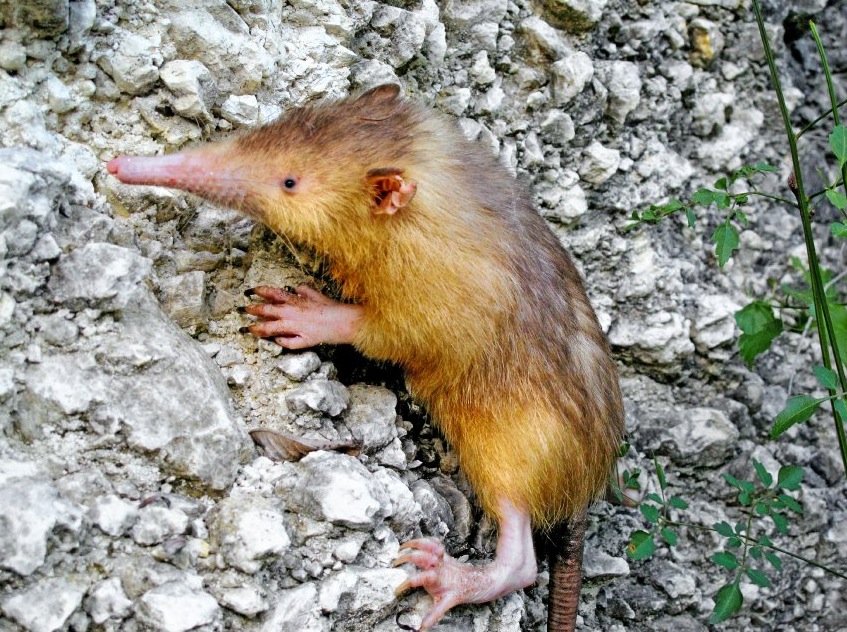
    In der Karibik versuchen Biologen, den giftigen Schlitzrüssler zu retten. Der Säuger zählt zu den seltensten Arten der Erde. Dass er bislang überhaupt überlebt hat, grenzt an ein Wunder.

    Von

    Im Stockdunkeln schwärmen die Häscher aus. Gerüstet mit Kevlar-Handschuhen und Stirnlampen verschwinden die beiden Männer in der Nacht. Stundenlang ist nur noch das Zirpen der Zikaden, das Singen der Baumfrösche und das leise Wispern der Blätter zu hören.

    Dann, kurz nach Mitternacht, tauchen die zwei Fährtenleser aus dem Dorf Mencia im äußersten Südwesten der Dominikanischen Republik urplötzlich wieder auf. Am langen Schwanz baumeln in ihren Händen zwei Schlitzrüssler, struppig und rotbraun, mit einer Nase wie eine Karotte. Und der Biologe Jose Nuñez-Miño, für den die Einheimischen auf die Suche gehen, kann sein Glück kaum fassen.

    Im Jahr 1906 war der Naturforscher Alpheus Hyatt Verrill auf die karibische Insel Hispaniola gereist, um “Solenodon paradoxus” zu finden, den Dominikanischen Schlitzrüssler. “Hoffnungslos” sei es, des Tiers habhaft zu werden, warnten Kollegen, “genauso wahrscheinlich, wie Geister zu fangen”. Doch Verrill gelang der Coup. Ein Weibchen ging ihm in die Falle.

    Einhundert Jahre später sind Forscher dem Säuger wieder auf der Spur. Sie sorgen sich um das Überleben des nachtaktiven Tiers mit den winzigen Augen und dem merkwürdigen Rüssel. Rund 300.000 Euro hat die britische Darwin Initiative für das “Hispaniolan Endemic Land Mammals Project” bereitgestellt. Im Oktober erst startete die einzigartige Rettungsmission.

    “Wenn wir sie verlieren, gibt es nichts Vergleichbares mehr auf der Erde”

    “Schlitzrüssler sind lebende Fossilien und gehören zu den frühesten höheren Säugetieren der Erde”, erklärt Nuñez-Miño, der für den federführenden Durrell Wildlife Conservation Trust arbeitet. “Wenn wir sie verlieren, gibt es nichts Vergleichbares mehr auf der Erde.” Schon vor rund 76 Millionen Jahren – die Dinosaurier stampften noch über die Erde – huschten die Vorfahren der ulkigen Geschöpfe durchs Unterholz. Und noch etwas ist an ihnen besonders: “Sie sind die einzigen lebenden Säuger, die mit ihren Zähnen Gift injizieren können, ähnlich, wie es Schlangen tun”, sagt Samuel Turvey von der Zoological Society of London.

    Der Biologe arbeitet am Projekt “Edge” (“Evolutionary Distinct and Globally Endangered”), das die 100 seltensten und evolutionär einzigartigsten Säugetiere der Erde retten will. Der Chinesische Flussdelphin gehört dazu, der eierlegende Langschnabeligel oder die Hummel-Fledermaus, der wohl kleinste Säuger der Welt.

    Der Schlitzrüssler ist die Nummer vier auf der Liste. Und er steht exemplarisch für eine Vielzahl einmaliger Kreaturen, deren größtes Problem es ist, in ein Inselparadies ohne natürliche Feinde geboren zu sein. Schon die ersten Bewohner Hispaniolas begannen, den Wald abzuholzen. Erste Teile des Schlitzrüssler-Lebensraums gingen verloren. Die europäischen Invasoren setzten den Kahlschlag fort. Noch fataler indes war, dass die Europäer Hunde und Katzen einschleppten. Für die Raubtiere war der Schlitzrüssler leichte Beute.

    Längst steht der knuffige Säuger auf der Roten Liste der bedrohten Arten. Fast an ein Wunder grenzt es, dass es ihn überhaupt noch gibt. In Haiti hält er sich nur noch an den Hängen des Massif de La Hotte im äußersten Südwesten. Das letzte lebende Exemplar einer kubanischen Schlitzrüssler-Art wurde 2003 gesichtet. Die Dominikanische Republik jedoch, so hoffen Experten, könnte noch eine kleine überlebensfähige Population beherbergen.

    Über eine holprige Piste geht es am anderen Tag hinauf nach Mencia, das direkt an der Grenze zu Haiti liegt. Am Steuer des Geländewagens sitzt Jorge Brocca von der Naturschutzorganisation Sociedad Ornitología de la Hispaniola. Zusammen mit Nuñez-Miño betreut er das Projekt vor Ort. Die Biologen sind hoffnungsfroh. Eben haben sie eine ihrer Videofallen geborgen, die sie im Wald installiert hatten.

    Ist ein Schlitzrüssler nächtens durch den Laserstrahl getappt, der die Kamera auslöst? Nuñez-Miño startet den Computer. Die Forscher verstummen andächtig, als sie die kurze Videosequenz sehen: Da tapst das Tier, schwankend wie ein Seemann, tatsächlich durch die Tropennacht. “Nie zuvor wurde ein Schlitzrüssler in freier Wildbahn gefilmt”, schwärmt Brocca.

    Kurz zuvor hatten die Biologen im Wald “Nasenstupser” entdeckt: kegelförmige Löcher im Waldboden, die der Säuger auf der Suche nach Insekten hinterlässt. Ohnehin ist der Schlitzrüssler ein skurriles Wesen: Die Zitzen der Weibchen sitzen in der Leistenregion. Die Muttertiere schleifen ihre daran hängenden Jungen hinter sich her, berichtet Nuñez-Miño. Merkwürdig auch das laute Zwitschern und Zirpen der Tiere, sobald sie gestört werden – oder der Gang, langsam und breitbeinig wie Sumo-Ringer.

    –> Geschichte auf SPIEGEL Online lesen

    Verwechslung mit dem einheimischen Mungo

    Bei schwarzem Kaffee mit Zucker und Zimt erörtern die Biologen die Lage. Bis heute brennen die Bauern vor allem im bitterarmen Haiti Wälder nieder, um Holzkohle für ihre Kochstellen zu gewinnen. Zudem verwechseln die Einheimischen den Schlitzrüssler häufig mit dem Mungo. Das eingeschleppte Raubtier meuchelt Hühner und Hähne der Dorfbewohner. Für dominikanische Männer jedoch ist Hahnenkampf eine todernste Angelegenheit. Können die Forscher den Menschen erklären, dass der Schlitzrüssler schuldlos ist am Geflügeltod?

    Auch die Jagd ist problematisch: Die Einheimischen stellen in den Wäldern verwilderten Schweinen und Ziegen nach. Ihre Jagdhunde lassen sie dabei auch nachts frei herumlaufen. Zusammen mit verwilderten Hunden sind sie die größte Gefahr für den Schlitzrüssler. “Wir wissen, dass Hunde immer wieder Exemplare der Säuger töten”, sagt Nuñez-Miño.

    Doch es geht auch andersherum. Der Biss eines Schlitzrüsslers, gut gesetzt, kann einen Hund zur Strecke bringen. Giftiger Speichel fließt dann durch Rinnen in den unteren Schneidezähnen des Tiers. Ähnlich funktioniert das bei Schlangen.

    Tötet der Schlitzrüssler auch seine Beute mit dem Gift? Die Forscher wissen es nicht. Ohnehin beginnen sie fast bei null. Die Gesamtzahl der Tiere? Unbekannt. Das Verbreitungsgebiet? Unklar. Auch die Lebensweise liegt noch weitgehend im Dunkeln. Bald wollen sie einige der Tiere mit Sendern ausstatten, um ihnen zu folgen. Doch wie fängt man einen Schlitzrüssler? Erfahrene Fährtenleser sind rar.

    Mit Sardinen, Erdnussbutter und Salami versuchten die Biologen zuletzt, die Tiere in Fallen zu locken. Ohne Erfolg. Im Zoo der dominikanischen Hauptstadt Santo Domingo werden nun erstmals die kulinarischen Vorlieben der Säuger ergründet. Drei Tiere hausen dort auf Betonböden in kleinen Räumen. Ihr Fell ist grau geworden. Bislang wurden die Insektenfresser mit Pferdefleisch gepäppelt. Doch was fressen sie in der Wildnis? Testweise kredenzen die Forscher nun Tausendfüßer, Mäuseembryos und Katzenfutter.

    Zäh und andpassungsfähig

    Zoodirektorin Patricia Toribio plant zudem ein Zuchtprogramm, oftmals die letzte Chance für akut gefährdete Tierarten. Noch kann das aber nicht klappen: “Unsere drei Tiere sind allesamt Männchen”, räumt sie ein.

    Wird das alles reichen, um den Schlitzrüssler zu retten? Die Geschichte Hispaniolas spricht dagegen. Rund 25 einzigartige Säugerarten lebten einst auf der Insel, unter ihnen Faultiere, Spitzmäuse und sogar eine Affenart. Bis auf zwei Arten, das rattenähnliche Zaguti und eben den Schlitzrüssler, sind sie alle längst ausgestorben.

    Die Biologen sind dennoch zuversichtlich. Als die Hitze des Tages weicht, bringen die Fährtenleser die markierten und vermessenen Tiere zurück in den Wald. Neben einer Kuhweide unweit des Dorfes haben sich die Säuger angesiedelt. Vielleicht können sich Schlitzrüssler und Mensch doch arrangieren?

    “Der Schlitzrüssler ist ein zäher, anpassungsfähiger Charakter”, sagt Nuñez-Miño. “Sonst wäre er auch längst von der Insel verschwunden.”

    –> Geschichte auf SPIEGEL Online lesen

  • Chaos in the Doctor’s Office: Panic in Germany as Swine Flu Spreads

    Fear of swine flu is running rampant in Germany as the number of reported cases — and deaths — continues to grow. Doctors’ offices are inundated by people wanting to get the vaccine, which is in short supply. But health professionals are divided over how dangerous the virus really is.

    Death from swine flu comes unexpectedly, as was the case with six-year-old Kharra Skye Davis from Hot Springs, Arkansas, who spent 20 hours fighting for her life, and with Kyree James Gamble, 5, from Littlestown, Pennsylvania. Both were healthy children, and both lost their lives before they had truly begun.

    In the case of Kharra, who died in September, the cause of death was respiratory failure. The little girl had attended a birthday party, and by that evening she had a fever of 40.5 degrees Celsius (105 degrees Fahrenheit). Kharra quickly developed pneumonia, and by the next day … More